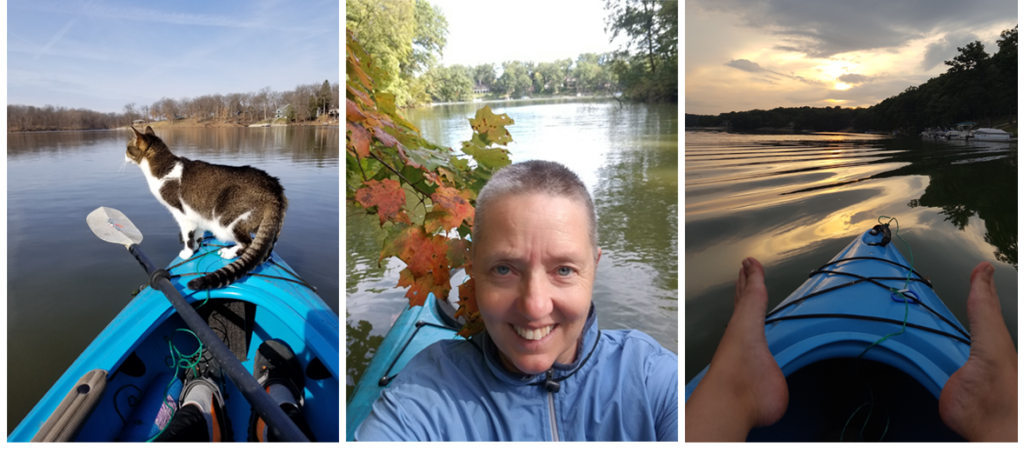
Right before Georgie fell in. After five years of being a kayak kitty.
Lesson for the day: a motivated cat can swim to shore. Even an old cat. Even a cat who looks like a skeleton draped in gorgeous fur. Even a cat who needs twice-daily meds. Even a 13+ year old cat whose brother died of kidney disease two years ago and who had a similar medical decline.
I went downstate from our Chicagoland apartment for the first time in almost six months – (okay, second, but the first was a one night quickie trip and it rained the whole afternoon so it barely felt like I was there). This was a whole week doing cat care while my husband was in DC for a conference. I felt like crap most of time. Accumulated cancer treatment toxins? Overwhelm and deep discouragement? Accumulated sleep deficit?! Fibromyalgia rearing its ugly and familiar head? But I felt just good enough one of the days there to walk down the sloping yard to sit on the rickety dock. All three cats followed me. They hadn’t had their humans at home and hanging around for way too much of the past year (plus) of my bleepity bleeping cancer year absence.
All three of the cats have been out on the water. They jump into the kayak while one of us is sitting alongside the sagging old wooden dock. They either like or don’t mind going out for a paddle.
I would rather keep them – especially Georgie – safely down and inside the cockpit of the boat, with maybe paws up on the side, looking out. Which Georgie does, for all of two minutes. But, like with children, no matter what I might clearly see as the best idea, a safe practice, a sound plan, the little wild ones end up doing things their own way and I have to scramble to adapt to keep them safe and sound.
Georgie hopped right up to the bow of the kayak, like a furry hood ornament. He does a circus worthy balancing act of staying there as I carefully paddle. Mind you, it is lake kayaking, not river, a mostly calm, still lake. And I paddle slowly when I have a feline friend aboard. Truth be told, I paddle slowly all the time now.
Over the four years we have been graced with this lake life, my concern for a cat-overboard moment strongly motivated me to try to find cat life jackets or small dog life jackets or find a small lifeguard donut I could throw out for a rescue. The solution that I landed on is to carry a pool noodle in the boat. I cut one of those foam noodles in half and always have it tucked at my side in the cockpit. At the ready. To reach out to any cat overboard. My thought was that they would grab it and either claw their way up it, or I could pull them up to the side and just lift them back in. I have rehearsed this in my mind. Many, many times.
Once upon my youth I was a lifeguard and was steeped in the safety motto: “reach or throw, don’t go.” Especially in open water, but even in a pool, lifeguards are encouraged to not get into the water for a rescue when an old-fashioned ring buoy, a shepherd’s crook, or the newer orange rescue tubes can be tossed out for someone-in-distress to grab onto and be pulled to safety. In lifesaving training we discuss and practice throwing in or using whatever is available as an extension or a flotation device: tossing ropes, using a towel, Styrofoam coolers. Anything to avoid getting into the water. As soon as a second person gets into the water to attempt a rescue then two people, not one, become at risk. So many things can go wrong.
But I knew that in a pinch I would get out of the kayak and into the water to grab a flailing cat. I’m a strong swimmer. I even know how to pull a swamped kayak to dry land, and I know that I could save a cat, swim, and pull the cat and the boat back to land. Not because I am strong or even well. Because I care that much. Oh, and – adrenaline. And, well, my personal ethics. I figure if I let a cat go on a boat with me, I am going to do whatever it takes to keep that cat safe. This isn’t as strong a drive as my mother bear instincts with my son (who now towers over me) but the compelling caregiver component is in full play.
Right after Georgie fell in.
He was on the bow one second, and suddenly he wasn’t. Because of all my mental practicing, and even physical run-throughs, in a split second I grabbed the pool noodle and swung it out of the cockpit and into the water towards Georgie. Never in a million years had it occurred to me that the cats wouldn’t just grab on, perceiving it to be a branch or log – a way up to dry land or safety.
Georgie gave me the briefest look of annoyance (okay, full on disgust), like “what the hell are you poking me with, can’t you see that I’m DYING here?” He looked towards shore and started “dog” paddling, head barely visible above water and his little front paws stroking away.
Oh, my heart!
All I could do was paddle with the care of a brain surgeon and be as close as possible to him to be of help without making his journey harder.
It might have taken two minutes but it seemed like twenty. He made it to our neighbor’s dock. It was the closest. He tried to claw his way up. Theirs is a respectable, solid affair, unlike ours which barely is above water. Theirs even has a dock ladder to get up and down into the water, their dock looms high above the water’s surface.
It was too much for him. Alarm bells went off in my brain. He was so close but had to be exhausted. The dock sat too high up for him, a good two feet up. I was about to go overboard and grab him when, somehow, his claws found purchase in the wood and he scrambled up.
He stood on the dock for a moment, stunned. My beautiful Abyssinian looked like wet roadkill. Then he made his way, drenched and wobbly, across the dock, up the plank to shore and up onto the shoreline.
I paddled like crazy over to our saggy dock, hauled my body up and out of the boat as fast as I could – no easy feat these days – tied my kayak off, leaving in in the water, which I rarely do, and climbed up our stairs and followed him into our yard.
The mad swim to shore used much of his adrenaline. His instinct was to find a warm, dry spot and keep on licking until he was almost bone dry. He chose a thick bed of overwintered oak leaves, in full sun, and got to work licking himself dry. Licking and licking and licking. First his toes, then forearm, then upper arm. Never stopping. He even did that adorable thing of keeping on licking, pink tongue going in and out, even when he was transitioning from area to area and not actually licking.
I don’t know from whence he was drawing his energy for this thorough lick-drying. He seemed to be on automatic. He moved systematically from head to tail. To his hind legs. Then chest, belly, and finally working almost feverishly at his back paw pads.
I stood over him. I’d like to say prayerfully but I was awash with the jitters of adrenaline flowing out.
His persistence in getting dry, his will to survive, to do what needs to be done, as long as it takes, marveled me.
After he seemed spent from his natural feline instincts, I scooped him up, took him inside, and made him into a cat burrito in a thick towel. I held him and cooed. He relaxed. It was the last time I let him join me in the kayak. But he would stay at the edge of the dock watching and waiting, whenever I went out for my slow, gentle paddles for the next several years of his full, much loved, life.